Series: How organisations undermine their anti-racism work.
Part 2 - How organisations bend to white supremacy and show a total inability to combat racism.
July 2026
At Hue we have been running workshops from an anti-oppressive and anti-racist lens for 7 years, and we have collected a lot of feedback. Most speaks to our incredible facilitation, deeply challenging content and ability to communicate complex ideas in accessible ways. But not all the feedback we receive is positive.
Like any organisation constructive feedback has provided us great insight into ways to improve safety, ways to refine our content, what concepts land and which require more time and exploration. Constructive feedback has helped us to improve our processes, honour our own boundaries and communicate expectations upfront. All organisations and practitioners can benefit from meaningfully integrating feedback and taking accountability for harm or opportunities for improvement. But one issue we come up against over and over, is racism and defensiveness disguised as feedback, and that organisations (and the people running them) do not know the difference.
When organisations bring racism and defensiveness disguised as feedback, the pattern is often the same:
During the workshop, a (white) participant becomes noticeably defensive over some information about racism, they react, become angry or argumentative, express racist views or ideas and speak over the top of others and the facilitator.
After the workshop, the organisation contacts us asking to meet, with the addition of a senior staff member who has previously not been engaged or in any contact with us.
When asked, they offer no information or context for what they want to meet about, but send through calandar invites as if they are entitled to our time.
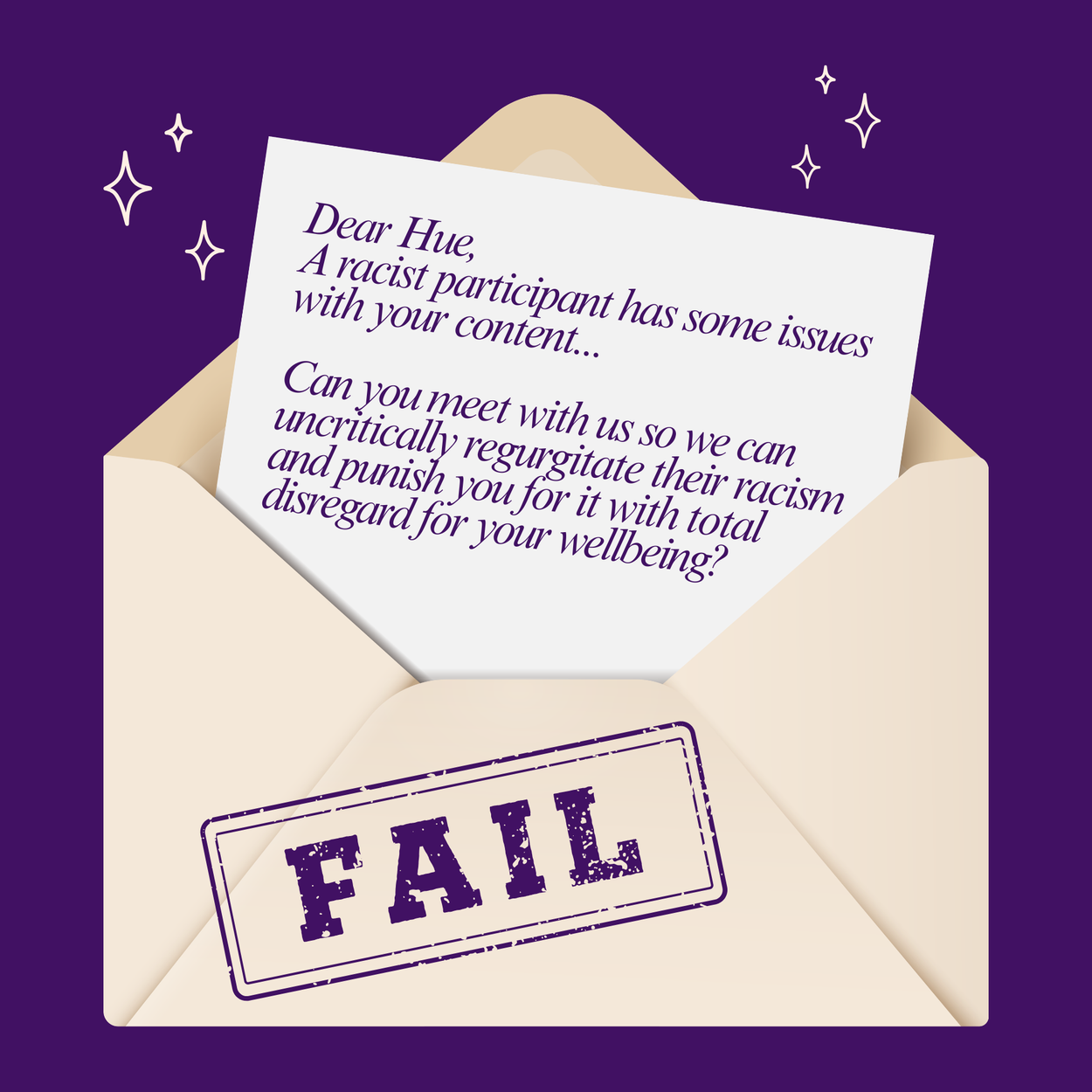
Having previously attended these meetings in good faith with little context and no support we have learnt that these meetings are often traumatising. A group of people you've never met, all with far more institutional power and white privilege, interrogating you about your supposed reverse racism. In these instances, these meetings feel more like disciplinary hearings, where we are forced to defend any range of blatantly racist accusations and fragile narratives. There is no care for our wellbeing or the experience of our facilitators and no understanding of how they are enforcing, enabling, and escalating the racist behaviour.
Having navigated this experience multiple times now, we are far more protective of our time, energy and emotional safety. We are not willing to attend an ambush of white authorities enacting racial supremacy, under the guise of process or feedback.
Most recently we sent this email in response to an organisation that had contacted us for a “feedback meeting” after asking for our personal phone numbers (no chance).
Hi _____,
Thank you for reaching out. We value our long standing relationship with Blank of Blank and we are open to hearing reflections about the workshop and appreciate organisations taking the time to engage thoughtfully with the work afterwards.
Before moving forward, we think it is important to distinguish between feedback and complaints. In anti-racism and anti-oppression work, particularly when conversations centre power, privilege and systemic harm, it is not uncommon for participants, especially those in positions of social or institutional power, to experience discomfort, defensiveness or challenge. Discomfort in itself is not necessarily an indication that harm has occurred or that the workshop was inappropriate.
As queer people of colour facilitating this work, we also navigate the reality that responses framed as “feedback” can at times reproduce racism, homophobia or resistance to conversations about power and oppression particularly as it impacts black and brown members of the LGBTIQA+ communities, and those oppressed by colonialism and imperialism. Since our facilitator did navigate some racist attitudes and pushback from a couple of participants during the workshop, particularly on the issue of LGBTIQA+ struggles being co-opted to legitimise the military industrial complex, we are curious if this is the context for this feedback. Wherever possible we would like to avoid repeating or escalating the racism already displayed by some participants in the session. Because of this, we ask you to carefully consider the nature of the concerns being raised, the context in which they emerged, and whether they are about actual facilitation issues, or discomfort with the content and its challenge to privilege.
We would appreciate clarity on whether this is being raised as:
general participant or organisational feedback for reflection, or
a complaint relating to feelings of discomfort and being challenged.
We would also encourage consideration of how any next steps are approached, particularly in ways that do not unintentionally centre the comfort of people in positions of privilege over the psychological safety and lived realities of marginalised participants and facilitators.
We are happy to decide how to continue the conversation once we have a clearer understanding of the context and intent of the concerns/feedback being raised.
To date, we have not received a response.
Even after doing the additional unpaid labour of responding respectfully, articulately and calmly and providing an opportunity to do better most of the time we are met with complete silence & not even an acknowledgement email, or worse: PR speak & legalese designed to deflect, obfuscate and avoid accountability or legal recourse in the instance of end of contract.
Organisations all tend to respond in equally unaccountable and racist ways, unable to discern between feedback of racial harm, and feedback of racial supremacy. This has become a recognisable and predictable experience for us at Hue. When a racist outburst occurs in a workshop it is not surprising that that person attempts to escalate their racism using the institutional power at their disposal. This is how white supremacy has been enacted and upheld since colonial systems were created- and yet it is still disappointing when organisations fail to challenge the obvious white supremacy arising in their own organisations.
Here are 4 tips and insights to avoid these common failures.
1. Does this feedback align with, or challenge the status quo?
Feedback that entrenches supremacy can be spotted by how it aligns with the dominant perspective and current power structures. There is a trend of framing ideas that entrench supremacy as “adding nuance”, “holding multiple truths at once” or applying a “critical lens”. This is linguistic deception and dishonesty. Language once used to assert the perspectives of the silenced and marginalised becomes a self-aggrandising tool of white supremacy to make bigotry sound enlightened.
The same practice that depicts western cultures as more civilised or intellectually advanced than the people they oppress. We see this tool adopted in even liberal and leftist spaces, where people’s defensiveness and racism is more insidious, hiding fragility and racism through the coded language of intellectual pursuit. We can clock if feedback or critique upholds supremacy by who it actually supports: the marginalised or the dominant group.
2. Can we apply an anti-racist lens to this feedback and when we do, what do we find?
Organisations skip the labour of critically reflecting on feedback from an anti-racist lens, instead taking it on face value, and missing an important opportunity to develop and practice their own anti-racist skills. If the feedback is that “it was racist towards white people” (which it always is in a range of different words), what knowledge of racism could we employ here to analyse and understand this feedback?
When organisations refuse to apply an anti-racist lens to feedback they receive, they demonstrate the racism that lives in themselves and their organisations. They participate in the racism instead of challenging it.
3. What positionality does this person occupy?
When a white person provides negative feedback about an anti-racism workshop, it is usually reflective of their racism. This isn’t to say you can always discern someone’s racism by their identity, black and brown people internalise racism too, and white people have the capacity to listen, learn and discern. But looking at someone’s positionality will often give you insight regarding the perspective of their complaint.
Is this person part of the dominant group? Do they occupy a position of relative privilege over the facilitator or groups whose perspectives are being shared? Are they in a position of relative power institutionally themselves?
Considering every piece of feedback we’ve received of this nature comes from people from the dominant group and in relative positions of power, this tends to be a good predictor. Predictably, complaints from people in positions of power are escalated far more often than those from marginalised people.
4. Can we notice defensiveness or fragility from this person regarding information about racism?
When people receive feedback, it often produces a stress response. It activates our nervous systems and our capacity for analysis goes offline. But remaining calm and grounded can offer us insight and perspective, and allow us to take in information we might otherwise ignore when in a state of stress (somatic insights like these are covered in our upcoming workshop, Somatics for Leadership). Stress can prompt us to respond with urgency and haste, rather than use our discernment to reflect meaningfully on the situation. When we pause we can observe.
Is this person demonstrating an understanding of anti-racism and an ability to take on information that challenges them? Or are they in a state of defensiveness and fragility about information about racism that they don’t like?
Someone who is defensive will reframe black and brown people talking about racism as an experience where they were harmed and victimised. Someone who is being fragile will centre their own distress over the lived realities of oppression for black and brown people.
Taking time to thoroughly and critically challenge racism in our organisation includes responding to racism framed as feedback, and is your first opportunity post-workshop to put your knowledge to use.
To read Part 1 of this series click here.
Interested in our workshops, facilitation or consulting? Contact us and let’s chat about how we can support your organisation.